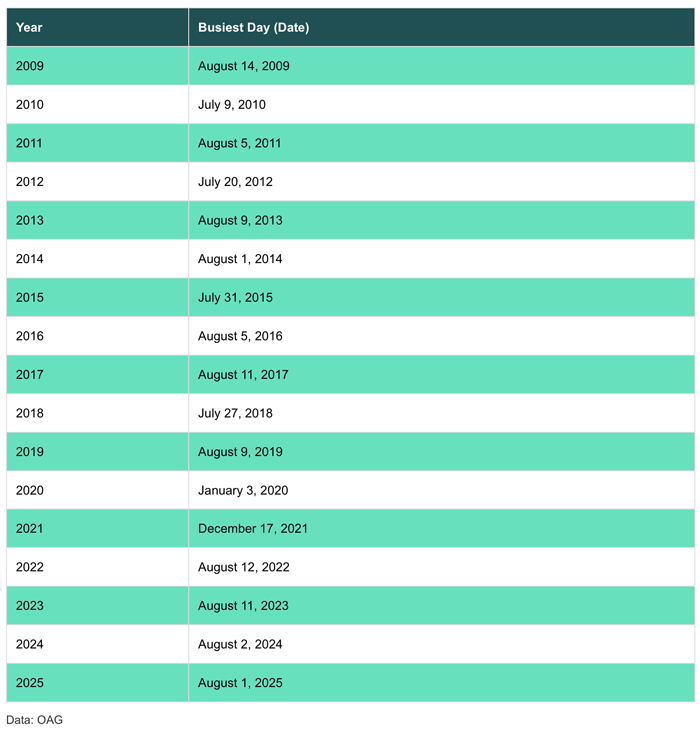
Over the past sixteen years, the busiest air travel days always fall on a Friday.
Global commercial aviation in 2025 continued its strong post-pandemic rebound, with seat capacity hitting record levels and distinct seasonal travel patterns emerging. OAG’s annual datasets provide an overview of how demand fluctuated throughout the year and which airlines and airports dominated on the busiest days worldwide.
The busiest air travel day of the year
Friday, 1 August 2025, was the single busiest day of the year for global air travel, with approximately 19.8 million airline seats scheduled worldwide — a figure that exceeded the busiest day of 2024 by more than 555,000 seats.
Historically, OAG finds that the busiest travel days each year tend to fall on Fridays in July or early August. Airlines plan their summer capacity to meet this peak demand for leisure and family vacations.
Late July and early August remain a global peak period for air travel, as schools and many businesses are on holiday and families take extended breaks. The COVID-19 pandemic shifted this trend in 2020 and 2021, with the busiest days occurring in January and December.
Every busiest air-travel date identified by OAG since 2009 has fallen on a Friday. This shows that end-of-week departures—especially in late July or early August—consistently drive peak global airline capacity.
This concentration of capacity reflects coordinated airline scheduling strategies as carriers anticipate peak leisure and VFR (visiting friends and relatives) travel demand. With Northern summer travel still a major driver of global aviation traffic, August remains the month to watch and perhaps avoid, if you’re trying to dodge crowds at the terminal. However, as OAG points out, severe weather or airline IT failures can lead to stressful travel days with crowded airport terminals at any time of year.
The slowest air travel day of 2025
By contrast, the quietest global air travel day in 2025 was Tuesday, 28 January, with 15,200,778 scheduled seats worldwide.
January—particularly the last full week—typically sees demand slump as the Christmas and New Year’s travel rush recedes and business travel hasn’t yet ramped up.
Tuesdays are generally among the lowest-traffic days of the week for air travel, with fewer business trips originating or terminating than on Mondays or Fridays.
For airlines, this trough presents both operational challenges and opportunities: capacity may be reduced to match demand, but it also offers a window for maintenance and crew rest scheduling with minimal passenger disruption.
The top 5 busiest airports on the busiest travel day of 2025
On the busiest day of 2025 — August 1 — the top five global airports by seat capacity were:
- Atlanta Hartsfield-Jackson International Airport (ATL)
- Dubai International Airport (DXB)
- Chicago O’Hare International Airport (ORD)
- Istanbul Airport (IST)
- Dallas/Fort Worth International Airport (DFW)
Dubai and Istanbul’s inclusion in this year’s busiest airports reflects their strong hub status for international travel. Atlanta has maintained a consistent presence on this list since 2009, ranking at the top every year except for one.
This year is also notable for having three of the five busiest airports located in the US. Looking at OAG’s historical trends for the busiest airports on the busiest days, dating back to 2009, the US has generally had two airports on the top-five list. One exception was 2015, when the US only had one airport on the list, with Atlanta at the top.
The COVID pandemic shifted these dynamics in 2020, with the top three busiest airports being Beijing, Dubai and Tokyo Haneda. Atlanta and Los Angeles ranked fourth and fifth, respectively.
Another remarkable year was 2021, when the US had four of the world’s five busiest airports on the busiest travel day. Atlanta held its leading spot, with Dallas-Fort Worth coming second, Los Angeles in fourth place, and Chicago O’Hare coming in fifth place. Dubai International Airport, which has ranked among the five busiest airports since 2015, came in third that year.
The busiest airlines by capacity on the busiest day of 2025
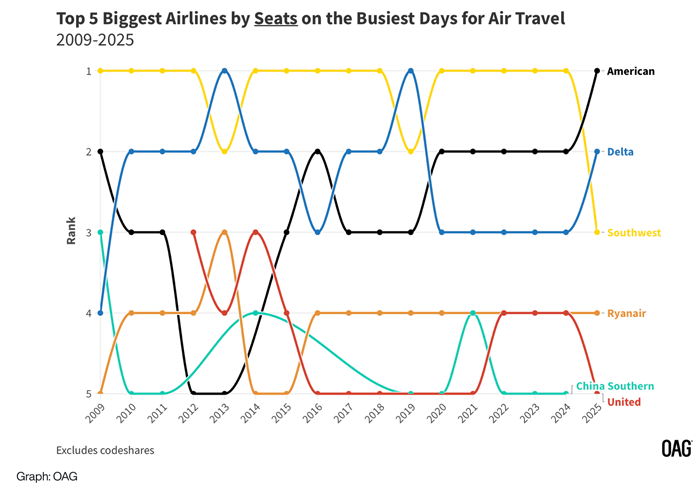
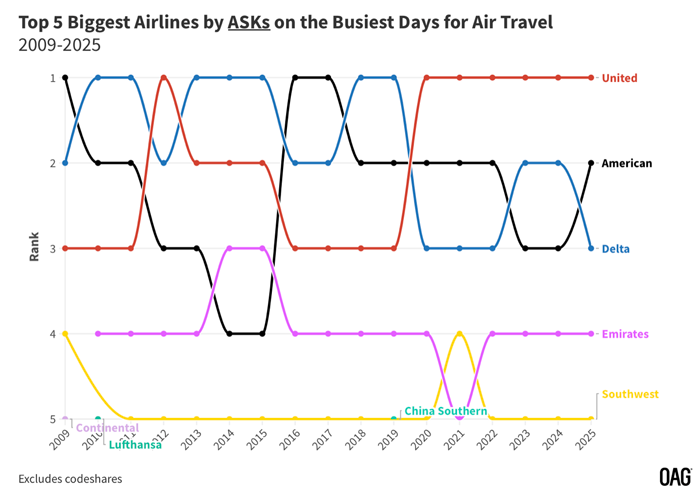
OAG’s analysis also breaks down the airlines with the highest capacity on the busiest travel day, looking at two different metrics:
By seat capacity (total seats scheduled):
- American Airlines
- Delta Air Lines
- Southwest Airlines
- Ryanair
- United Airlines
By Available Seat Kilometres (ASKs)—a measure that accounts for both capacity and flight distance:
- United Airlines
- American Airlines
- Delta Air Lines
- Emirates
- Southwest Airlines
These rankings show that major network carriers (American, Delta, United) dominate overall capacity. Emirates also makes a strong showing in ASKs due to its long-haul, high-yield routes.
According to OAG, Southwest, Delta, and United Airlines have historically competed for the top position by seats, with Southwest most often emerging as the leader. Reflecting its position as a short-haul carrier, Southwest ranks lower in ASKs, fluctuating between fourth and fifth place.
American, Delta, and United have shared the top spot as the largest airlines by ASKs on the busiest days of airline capacity since 2009.
Delta has held the top spot for seven years; United has been number one seven times (six of these since 2020), and American Airlines has ranked first three times.
What the busiest days of the year mean for air travellers
OAG’s data reveals annual rhythms in global travel demand, which can inform your air travel plans for 2026. Over the past sixteen years, the single busiest travel days have almost always fallen on Fridays in July or August, driven largely by summer vacations in key markets.
Although not always the busiest single days globally, travel in late December and around Thanksgiving in the US remains extremely busy, with authorities reporting record TSA screening numbers on key holiday dates.
On weeks following major holidays, demand typically declines. Late January 2025 clearly exhibited this pattern, becoming the year’s lowest-capacity day.
Mid-week air travel, most notably Tuesdays, tends to have less air traffic, as leisure flyers avoid weekday departures and many business travellers concentrate trips around Mondays and Fridays.
Booking mid-January or mid-week flights can mean fewer crowds, lower stress and often better fares. Travellers planning summer trips—especially around late July and early August—should book well in advance to secure availability and favourable prices.
What the busiest days mean for airlines and airports
For airlines, planning rotational capacity and workforce around predictable peaks, such as August, helps optimise yields and resource utilisation. Seasonal troughs, such as late January, serve as crucial windows for maintenance and crew scheduling without disrupting traveller flows.
For airports, the busiest travel days of the year constitute a concentrated stress test, with terminals, runways, and support services operating near peak capacity for extended periods. Security screening, baggage handling, gate management, and staffing levels must be precisely scaled to avoid cascading delays.
Because these peak days are highly predictable—typically Fridays in late July or early August—airlines and airports can plan resources more effectively than during disruptions caused by severe weather or technical issues. So, the busiest day of the year doesn’t have to be the most stressful for air travellers.
What to expect from air travel in 2026
OAG’s 2025 air travel statistics provide robust views of the dominant trends in commercial aviation, which will inform the industry’s plans for the new year. With August 1 confirmed as the year’s busiest flying day and January 28 as the quietest, industry professionals and passengers alike can use these benchmarks to make smarter travel decisions — whether scheduling aircraft rotations or deciding when to book that next flight.
Copyright 2026 Aerospace Global News. All rights reserved. From https://aerospaceglobalnews.com. By Marisa Garcia.