Mews survey of 3,250 travelers finds the divide isn't whether they trust AI, but whether a decision is a chore or a choice
Key findings:
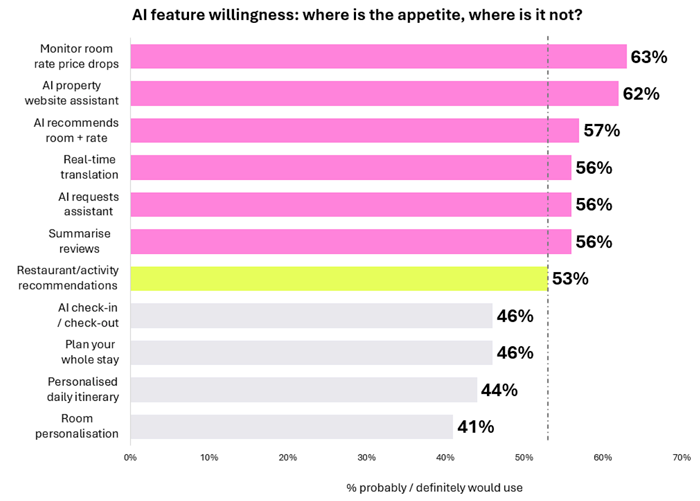
- 63% would use AI to monitor room-rate price drops
- 56% would use AI for real-time translation
- 57% would rather stay in control of their trip than hand decisions to an AI acting on their behalf
Travelers will let AI watch hotel rates (63%) and translate on the spot (56%) but far fewer want it planning their itinerary (44%) or personalizing the room (41%). That's according to a new survey of 3,250 travelers from Mews, and it comes down to one question: is the task a chore or a choice?
A price alert or a translation doesn't need anyone to know a guest personally. It just needs to be accurate and fast. An itinerary or a room setup is personal by definition, and 57% of travelers say they would rather stay in control of their trip than hand over those decisions to AI acting on their behalf. That's where hoteliers come in.
Guests trust the data they share, not the data gathered about them
Travelers are far more comfortable with AI drawing on what they've knowingly shared with a hotel, such as stated preferences (61%) and past stay history (56%), than on what's collected about them, such as online behavior (43%) or external and social data (34%). Guests aren't turning away from personalization. They care where it comes from, and it lands best when it's built on what they chose to share rather than what's been assumed.
Comfort with shared data is strongest in the US, where 63% are happy for AI to draw on their past stay history. Spain is the market most swayed by data transparency: 72% would be more willing to use AI-enabled services if they had transparency and control over their data.
The pattern holds across markets
In every country surveyed, travelers are less willing to use AI once it's running a moment of the stay than when it's helping them plan ahead. UK travelers show the functional mindset most clearly: they're the least likely to rate personalization during a stay as important (30% vs. 40% on average).
Italy and Spain are the most enthusiastic markets. Italian travelers are the most likely to expect check-in with no front desk at all (58% vs. 42% on average) and the most optimistic about AI's role five years from now (51% vs. 39% on average, the only market significantly above it). Overall, Spain has the most positive attitude to AI (58%), and the two countries are the only ones significantly more positive than the rest of the sample.
"Guests have told us where AI helps, and where it doesn't," said Josef Starýchfojtů, CPTO of Mews. "Having clever technology is great, but firstly, we should know whether guests want a task done for them or want to be part of it. Get that wrong and even good AI feels intrusive. We're building for human hospitality: technology handles the mundane, repetitive admin, and hotel teams have more time for their guests."
Copyright Mews. All rights reserved. From https://www.mews.com.